Physics · PHY-002
Momentum & Collisions
Two carts bounce, stick, or push apart. What stays the same?
- NGSS HS-PS2-2
- AP Physics 1 Unit 4
- AP Physics 1 Investigation 5
Included with a subscription. Create a free account to get started.

About this lab
Send carts toward one another and record their motions before and after a collision or separation. This interactive 3D experiment lets high school students choose masses, starting speeds, and collision arrangements, including rebounds, sticking carts, and release from a compressed plunger. The measurements feed signed momentum and kinetic-energy accounts for individual carts and the pair. Position traces include the center of mass, while force-time observations provide another way to compare the interaction. Repeated runs support analysis of external influences and measurement error. These activities are aligned with NGSS HS-PS2-2, AP Physics 1 Unit 4, and AP Physics 1 Investigation 5.
What you will investigate
This momentum collision virtual lab uses carts on a low-friction track to compare motion before, during, and after contact. Change masses and initial velocities, select a collision type, and examine a separation from rest. The investigation connects velocity records with system momentum, kinetic energy, center-of-mass motion, and force–time evidence.
Choose a positive direction before calculating momentum. A cart moving in the opposite direction has a negative velocity under that convention. Adding speed magnitudes instead of signed momenta can make a valid conservation comparison appear to fail. Keep the system boundary explicit: the momentum of one cart can change while the momentum of the two-cart system remains unchanged under the ideal external-force conditions.
An ideal equal-mass collision
The prompt's elastic reference uses equal cart masses of 0.250 kg, with cart A initially moving at 0.40 m/s and cart B initially at rest. The ideal track has no friction or tilt. The collision transfers the initial motion in the following defined comparison.
| Ideal elastic comparison | Cart A velocity | Cart B velocity |
|---|---|---|
| Before contact | 0.40 m/s | 0 m/s |
| After contact | 0.000 m/s | 0.400 m/s |
The system kinetic energy is 0.0200 J both before and after this elastic case. These are model validation values. They are not a general instruction to give every pair of colliding carts the same final velocities; a change in mass, initial motion, or collision type changes the comparison.
Momentum and kinetic energy answer different questions
For an isolated two-cart system, total momentum is conserved in an inelastic collision as well. Kinetic energy need not remain unchanged. The course's sticking comparison distinguishes kinetic energy from energy stored or transferred during contact. A decrease in kinetic energy is not a disappearance of total energy from the complete physical account.
The separation-from-rest investigation offers another useful contrast. The two carts move in opposite directions, and their momenta can sum to zero while their kinetic energies are both positive. The cart speeds depend on the masses. A larger kinetic-energy total after release is consistent with energy supplied by the release mechanism, rather than evidence that momentum was created from nothing.
Impulse and center-of-mass motion
The force–time comparison connects the area under a force curve with impulse and a cart's change in momentum. During contact, the forces on the two carts are equal in magnitude and opposite in direction. That does not require equal changes in speed when their masses differ. Pair the force explanation with the corresponding momentum change rather than inferring force directly from which cart looks faster.
The center-of-mass view supplies a system-level check. Without a net external force, its velocity remains constant through the collision. Follow the separate cart trajectories and the center-of-mass trajectory to see why a sudden change in an individual cart's motion need not create a sudden change in the system's center-of-mass motion.
Real conditions and classroom discussion
Track friction and tilt act as external influences on the selected cart system. Measure the relevant velocities near the collision and explain those influences before treating a difference as a failure of conservation. The buffer-design extension also distinguishes peak force from total impulse: spreading a momentum change over a different contact history can alter the peak without making the needed momentum change vanish.
The course supports NGSS HS-PS2-2 and collision-protection reasoning associated with HS-PS2-3, together with AP Physics momentum topics. Ask students to compare signed momentum and kinetic energy for the same run, then defend their system boundary. Continue with Newton's second law or energy on a track.
Build an explanation from your records
Make a prediction before changing the conditions, then record a comparison that actually tests it. Keep the conditions attached to each row: a number without its setup can be misleading even when the arithmetic is correct. Explain what changed, what stayed fixed, and which observation supports your conclusion. If the result differs from your prediction, revise the explanation using the evidence rather than choosing a new answer without a reason.
The reference examples on this page describe the course model or its stated source data. They are not measurements collected from a physical laboratory by the reader. Compare like conditions, keep units visible, and distinguish rounded instrument displays from underlying model quantities. Use the investigation's stated limits when deciding whether a result can be generalized beyond the simulated setup. This guide supports preparation and interpretation; practical laboratory technique and safety training remain separate learning activities.
Common questions
Standards alignment
- NGSS HS-PS2-2
- AP Physics 1 Unit 4
- AP Physics 1 Investigation 5
More Physics labs
- Free demo
Physics
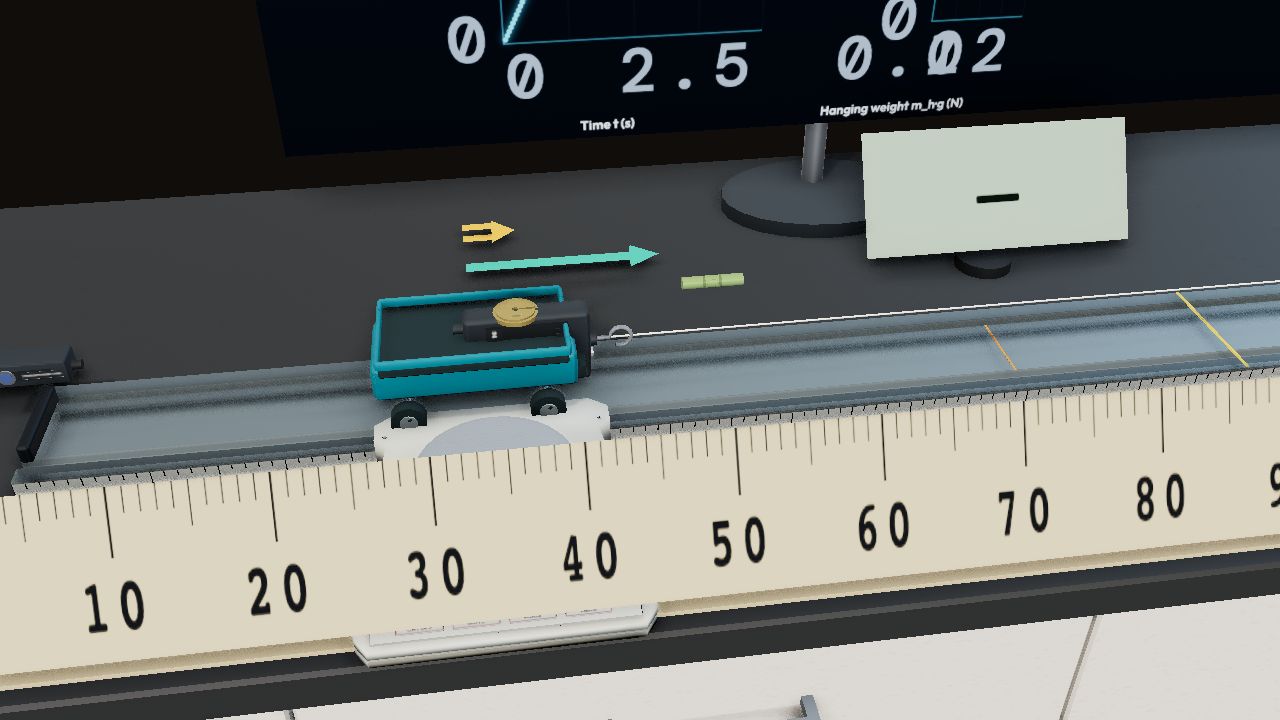
Newton's Second Law
A hanging mass pulls a cart over a pulley. What sets the acceleration?
- Members
Physics
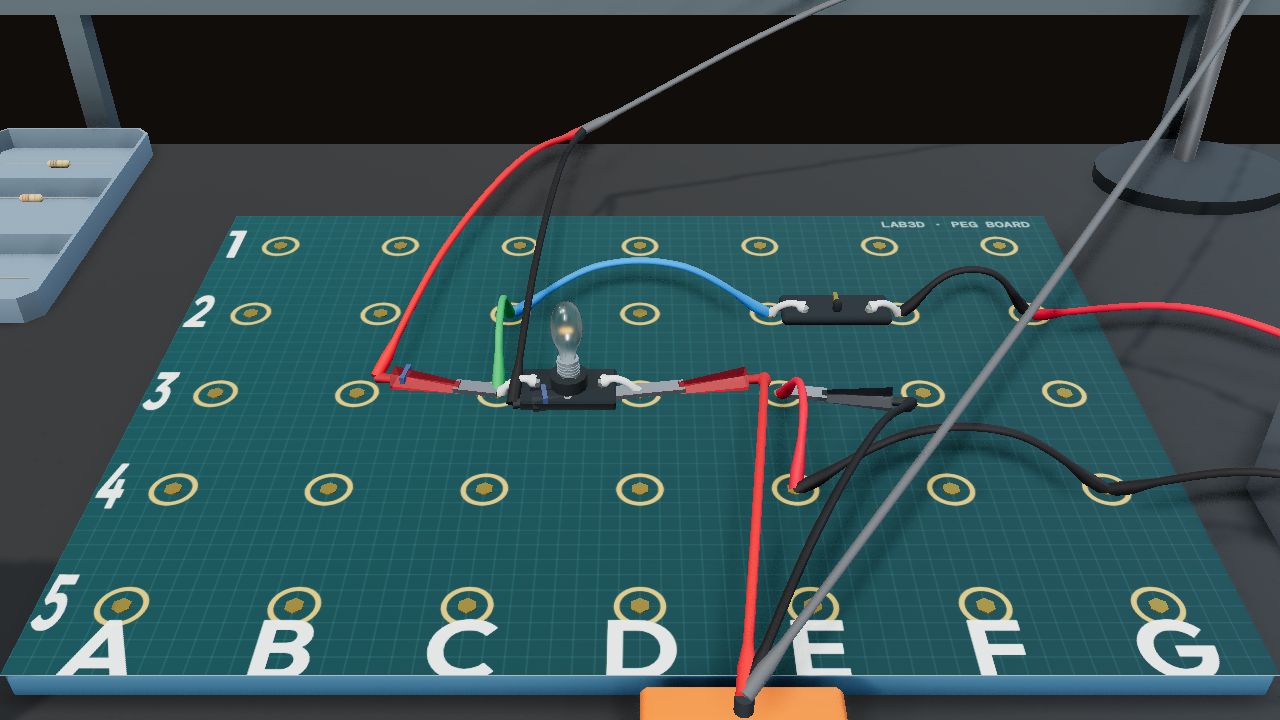
Ohm's Law & Circuits
Build series and parallel circuits and see the voltage landscape.
- Members
Physics
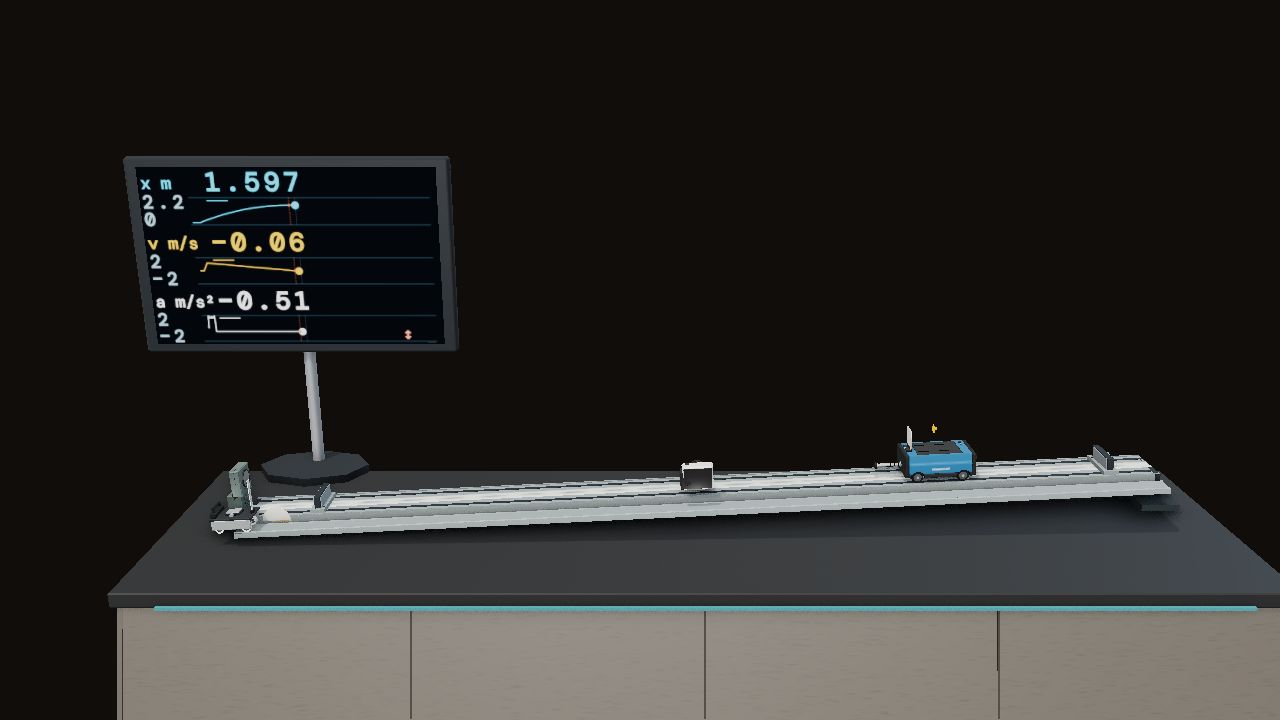
Motion Graphs & Reference Frames
Launch a cart up a ramp and watch its x–t, v–t, and a–t graphs draw themselves. Then measure the same run from a moving camera.


