Physics · PHY-001
Newton's Second Law
A hanging mass pulls a cart over a pulley. What sets the acceleration?
- NGSS HS-PS2-1
- AP Physics 1 Unit 2
- AP Physics 1 Investigation 2
Free demo. No account needed.

About this lab
Measure a cart's acceleration as a hanging mass pulls it along a track over a pulley. In this interactive 3D investigation for high school students, transfer weights from one part of the system to another, vary the cart load, and contrast experiments with fixed total mass or fixed hanging mass. Motion measurements produce velocity-time fits and acceleration comparisons. Force diagrams and tension readings accompany the cart, hanger, and combined-system views. The graph tools offer alternative axes, fit slopes, and residuals for comparing the experimental relationships. The investigation is aligned with NGSS HS-PS2-1, AP Physics 1 Unit 2, and AP Physics 1 Investigation 2.
What you will investigate
This virtual Newton's second law lab uses a cart, track, pulley, and hanging mass to study how acceleration depends on force and total moving mass. The cart and hanger form one system. Moving a mass from the cart to the hanger changes the driving force while keeping the system's total mass fixed. Adding a new mass from outside the system changes the total mass as well. That distinction is central to designing a useful comparison.
Predict how a velocity–time graph changes before running the experiment. Then identify the independent variable, measured response, and quantities held constant. One investigation varies the driving force at fixed total mass. Another changes the system mass while keeping the hanger's weight fixed. The different procedures test the two relationships in a = Fnet/M rather than mixing both changes into one trial.
The ideal cart-and-hanger model
On a level, frictionless track with an ideal pulley, the acceleration is a = mₕg/(mcart + mₕ). The denominator includes both moving masses. The hanging mass's weight drives the system, but it is not equal to the string tension. For the cart, T = mcart a. For the hanger, its weight and tension together produce its downward acceleration.
| Ideal setup | Model acceleration |
|---|---|
| Cart 0.250 kg, hanger 0.050 kg | 1.63333 m/s² |
| Cart 0.250 kg, hanger 0.020 kg | 0.725926 m/s² |
| Cart 0.500 kg, hanger 0.020 kg | 0.376923 m/s² |
| Cart 0.750 kg, hanger 0.020 kg | 0.254545 m/s² |
The first setup gives tension 0.408333 N. With a hanger travel distance of 0.80 m, its model landing time is 0.989743 s and the cart speed at that transition is 1.616581 m/s. These are ideal validation values for the stated conditions. They are not measurements taken from a physical apparatus.
Why doubling the hanger does not always double acceleration
Keep a 0.500 kg cart and increase the hanger from 0.020 to 0.040 kg. The ideal acceleration changes from 0.376923 to 0.725926 m/s², a ratio of approximately 1.9259. The driving weight doubles, but the total moving mass also increases. Use the system equation to explain why the acceleration ratio is less than two. A comparison that keeps total mass fixed by transferring masses tests a different condition.
The force diagram provides another check. If string tension equaled the hanger's weight, the hanger would have zero net force and would not accelerate. Compare the tension arrows with the acceleration and velocity arrows to keep the three concepts separate. Force controls changes in velocity; it does not simply determine the velocity already present at a particular instant.
Graphs and the landing transition
When the hanger reaches the floor, the driving condition changes. In the ideal model, the cart then coasts rather than immediately stopping. A graph spanning both phases should not be interpreted as one uninterrupted constant-acceleration motion. Identify the transition before using a slope to describe a particular segment.
For fixed total mass, plotting acceleration against driving force reveals a slope related to the inverse system mass. For fixed driving force, plotting acceleration against inverse total mass gives a straight-line comparison. In the ideal 0.020 kg hanger example, that slope is 0.19600 N and the intercept is zero. Choose axes that test a prediction and explain the units of the slope instead of fitting a line without a physical interpretation.
Real mode and model limitations
Real mode includes track friction, tilt, pulley inertia, and sensor effects. A frictional cart can slow after the hanger lands, and a sufficiently small driving force may not move the system. Repeated measurements can reveal scatter while a consistent offset may point to a systematic effect. Compare controlled trials and discuss how a tilt adjustment can compensate for friction, rather than assuming that every disagreement proves Newton's law is wrong.
The course models a specific cart-and-hanger arrangement. Its ideal formula is not a universal expression for every pulley setup, and the ideal values should not be applied unchanged to a tilted or frictional run. The particle-free mechanical model still requires selecting the system boundary and interpreting actual recorded quantities carefully.
Standards and classroom use
The course connects to NGSS HS-PS2-1 and AP Physics 1 force, motion, and experimental-analysis topics. Ask students to defend why their method holds mass or force constant, interpret a fitted slope, and explain the cart's behavior after the hanger lands. The public demonstration provides a way to explore these comparisons before handling a physical track. Continue with ripple tank waves for another investigation built around controlled measurements and graphs.
Common questions
Standards alignment
- NGSS HS-PS2-1
- AP Physics 1 Unit 2
- AP Physics 1 Investigation 2
More Physics labs
- Members
Physics
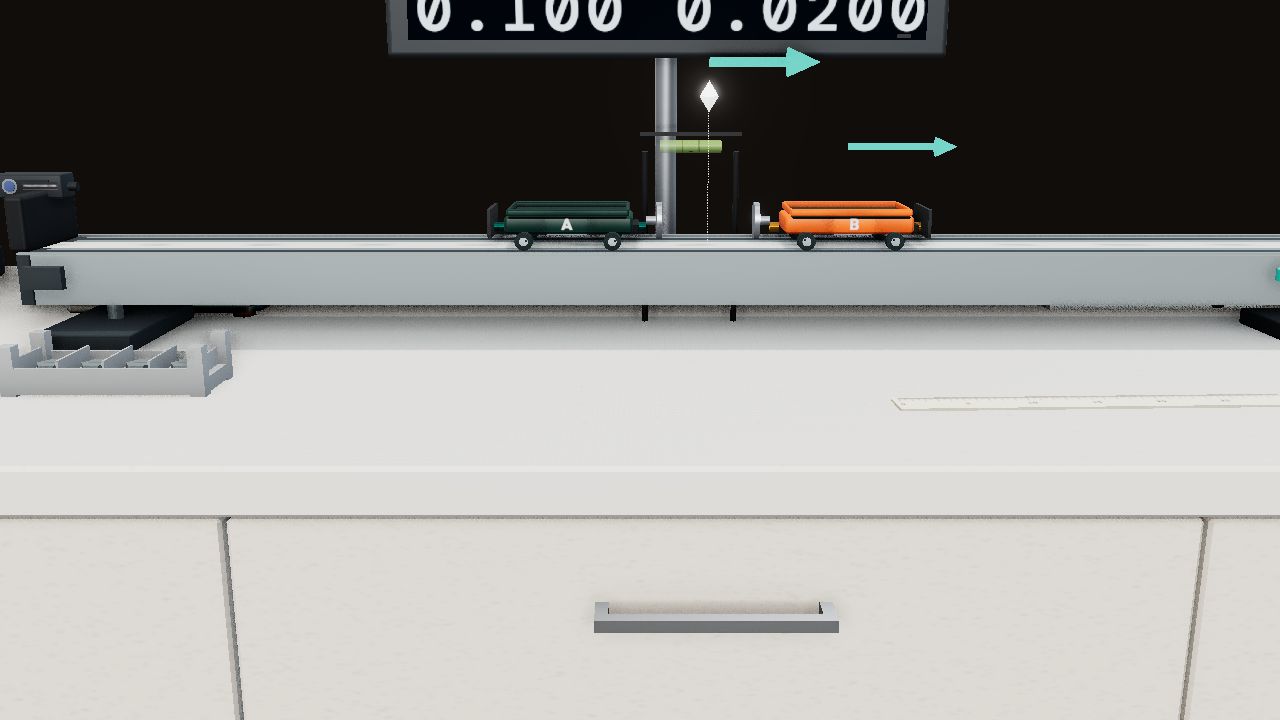
Momentum & Collisions
Two carts bounce, stick, or push apart. What stays the same?
- Members
Physics
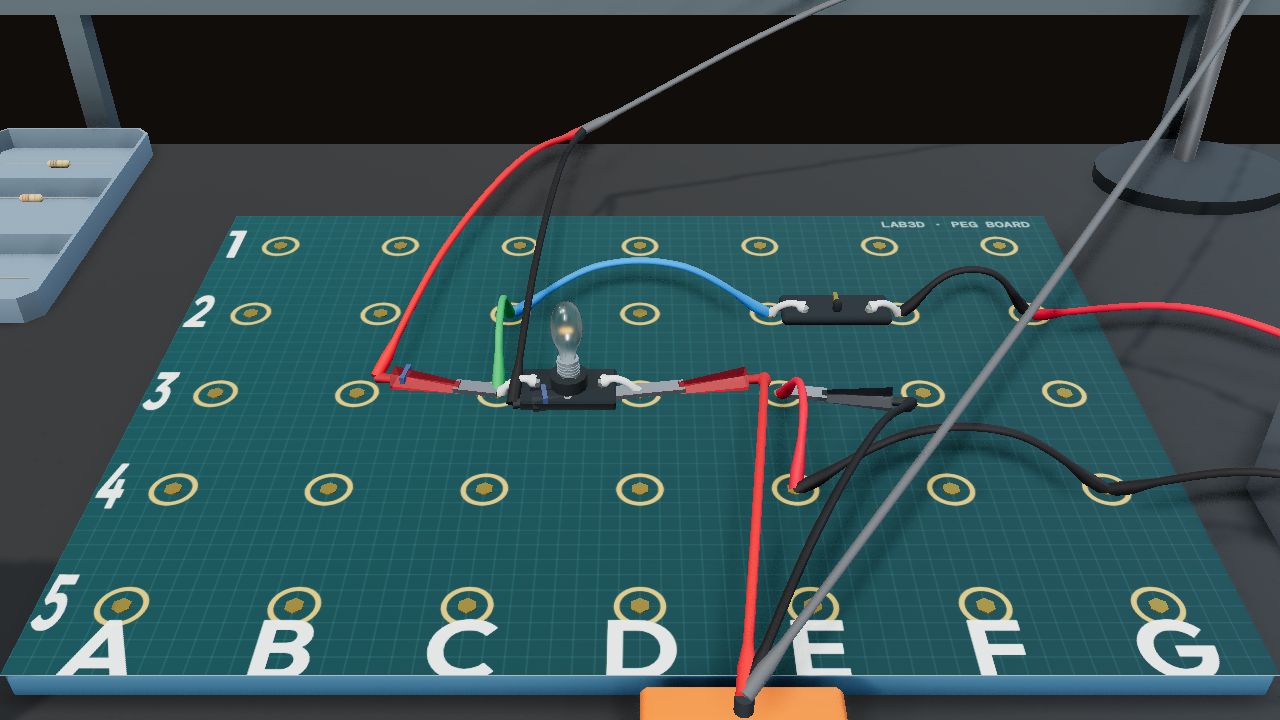
Ohm's Law & Circuits
Build series and parallel circuits and see the voltage landscape.
- Members
Physics
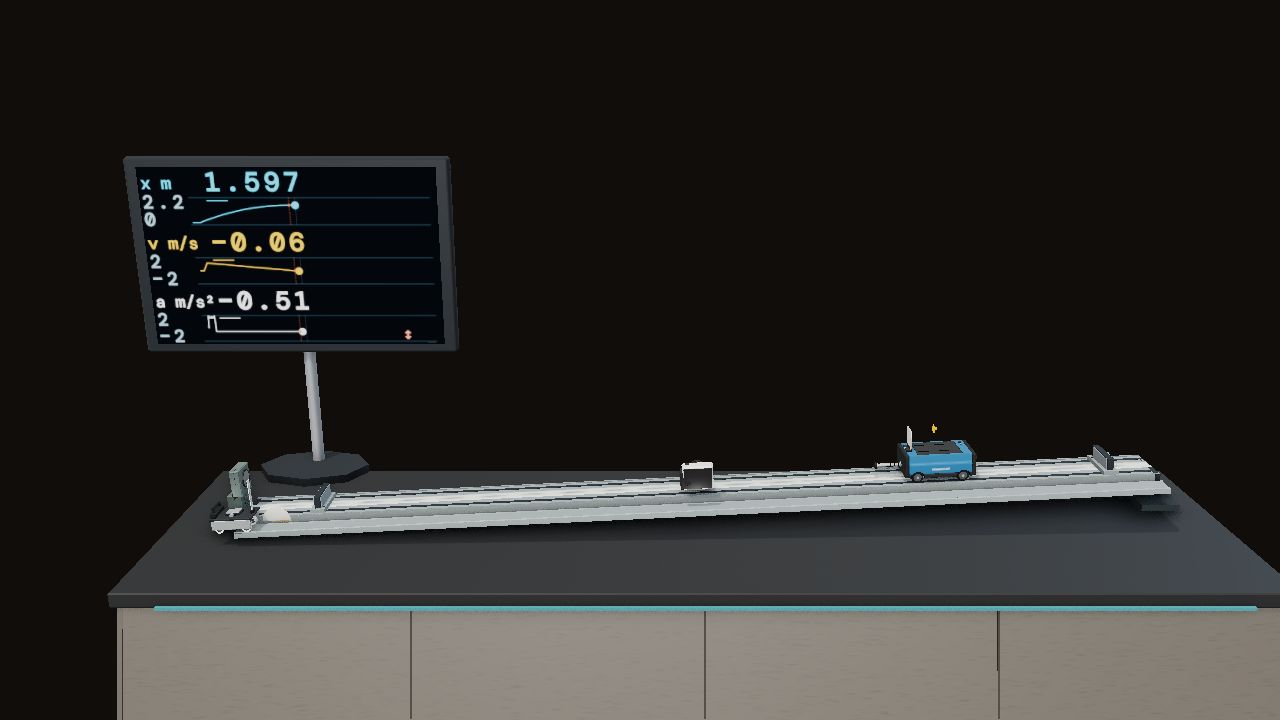
Motion Graphs & Reference Frames
Launch a cart up a ramp and watch its x–t, v–t, and a–t graphs draw themselves. Then measure the same run from a moving camera.


