Chemistry · CHM-003
Reaction Rates
Magnesium in acid: change one condition, time the gas.
- NGSS HS-PS1-5
- AP Chemistry Unit 5
- AP Chemistry Investigation 10
Included with a subscription. Create a free account to get started.

About this lab
Collect gas from magnesium reacting with acid and compare how quickly it is produced. High school students use the interactive 3D setup to alter concentration, heating conditions, exposed magnesium area, or catalyst use, arranging paired trials that differ in a single experimental condition. Gas-volume traces provide initial-rate estimates and comparisons of reaction progress. The magnesium-surface view accompanies collision counts, energy-distribution displays, and alternative activation-energy paths. Students examine which part of the measured curve changes and compare the timing with the final collected amount. These activities are aligned with NGSS HS-PS1-5, AP Chemistry Unit 5, and AP Chemistry Investigation 10.
The question behind the experiment
A reaction can finish sooner without making more product. This investigation separates those questions using magnesium reacting with acid and a gas-volume record. The curve carries information about both the speed of production and the final amount collected. Compare the early shape with the eventual plateau rather than describing an entire trial as simply fast or slow. The learning goal is to explain which part of the record changes when a reaction condition changes.
Plan a useful comparison
Design a comparison around concentration, temperature, or exposed magnesium surface. Keep the remaining conditions fixed, including the amount of magnesium when you want to compare rates rather than yields. Changing the reactant amount at the same time would make the plateau difficult to interpret. The course asks you to identify controls and recognize trials that are not fair tests. Write down the chosen factor before collecting a curve so the comparison has a clear question.
Connect the observation to the model
Use the slope of the gas-volume curve to describe the rate at a particular stage. An early tangent estimates an initial rate, while a line joining distant points averages over a changing reaction. Compare initial rates at different acid concentrations to investigate the concentration dependence. Do not compare one trial's initial rate with another trial's late rate. Those readings correspond to different amounts of remaining reactant and therefore answer different questions about the same chemical process.
Interpret the result carefully
The collision view gives distinct explanations for concentration and temperature. More available reactant particles can increase the frequency of encounters, while warming changes the fraction of encounters energetic enough to react. Surface area changes the accessible reaction sites. A catalyst provides a lower activation-energy pathway; it does not supply extra reactant or redefine the final chemical amount. Relate each explanation to a named feature of your curves rather than treating all faster reactions as the same mechanism.
Build an explanation from your evidence
Keep the ideal comparison separate from the course's modeled real-lab effects, including acid depletion and self-heating. Conditions can change during a run even when their starting settings match. Explain whether your rate comparison uses effectively excess acid or a finite acid sample. The optional Arrhenius extension is a further modeling activity, not a required AP exam calculation. A strong conclusion states what the controlled comparison supports and what a changing solution condition leaves unresolved.
A reference case from this course
For excess acid at 20.0 °C, the specified 0.040 g magnesium reference gives a final hydrogen volume of 39.59 mL. This is a model validation case tied to those conditions, not a general gas volume for every sample. Keep the magnesium amount and temperature attached when comparing the plateau with a trial you collect.
Keep the investigation reproducible
Before changing the setup, write a prediction that names the measured quantity and the expected direction of change. Retain the original trial as a reference. Record the apparatus conditions, units, and whether you used Ideal or Real lab mode. If the selected activity includes seeded variation, keep the seed and run identity with the result so another comparison does not silently mix different conditions.
Separate the observation from its explanation. A reading or a counted object belongs in the evidence; the relationship you use to interpret it belongs in the reasoning. When a result differs from the reference case, check the settings and measurement procedure before deciding that the model relationship has failed. Describe a specific source of uncertainty and where it enters your calculation. Finish with a claim supported by the recorded comparison, and identify an additional trial that could distinguish your explanation from an alternative.
Continue the comparison
Compare the concentration-time approach in Rate Laws: Crystal Violet, then examine the distinction between reaction speed and final state in Equilibrium. Each course follows a different measured quantity, so retain its units and chemical system.
Common questions
Standards alignment
- NGSS HS-PS1-5
- AP Chemistry Unit 5
- AP Chemistry Investigation 10
More Chemistry labs
- Members
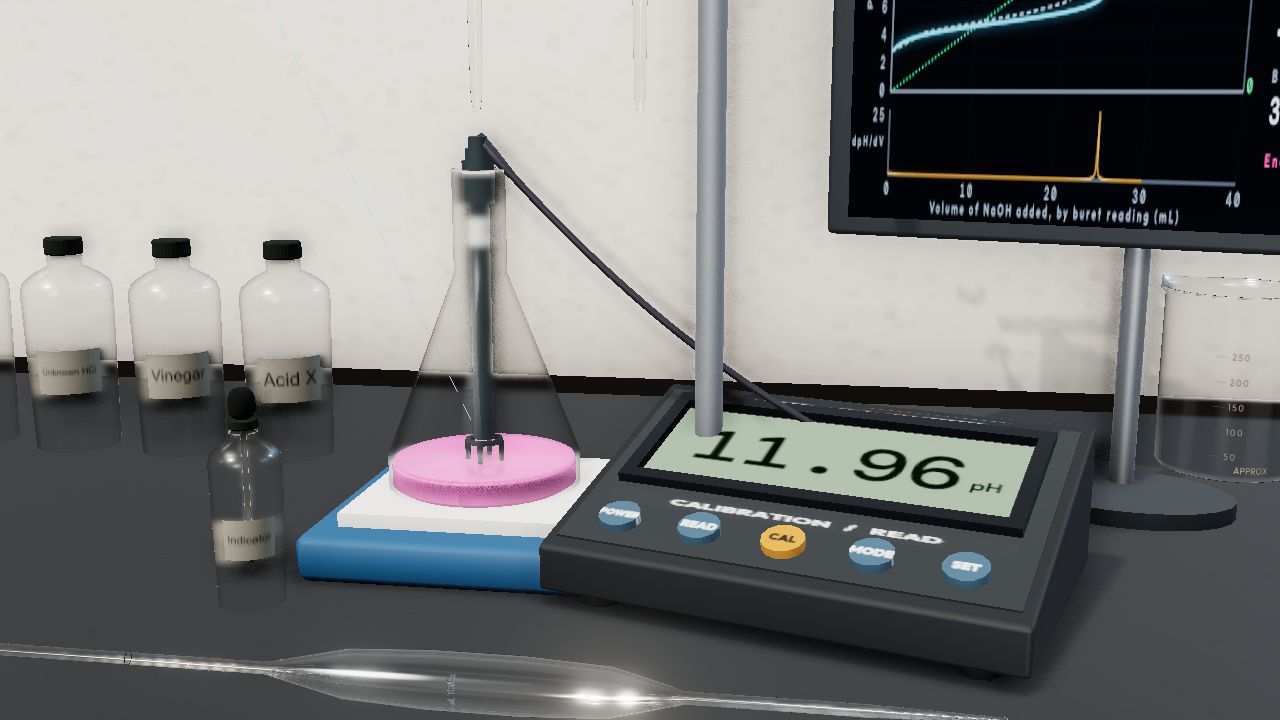
Chemistry
Acid–Base Titration
One drop, six pH units. Find the equivalence point and pKa.
- Members
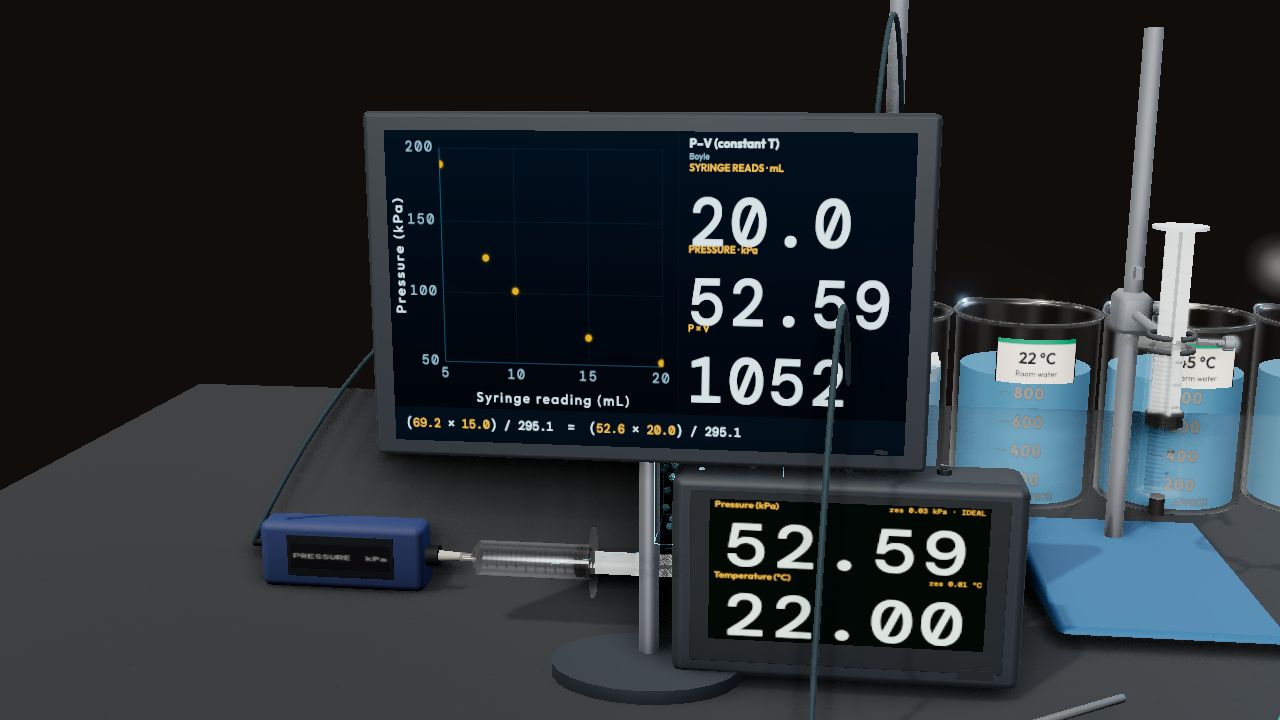
Chemistry
Gas Laws
Squeeze, warm, and cool trapped air. Find absolute zero.
- Members
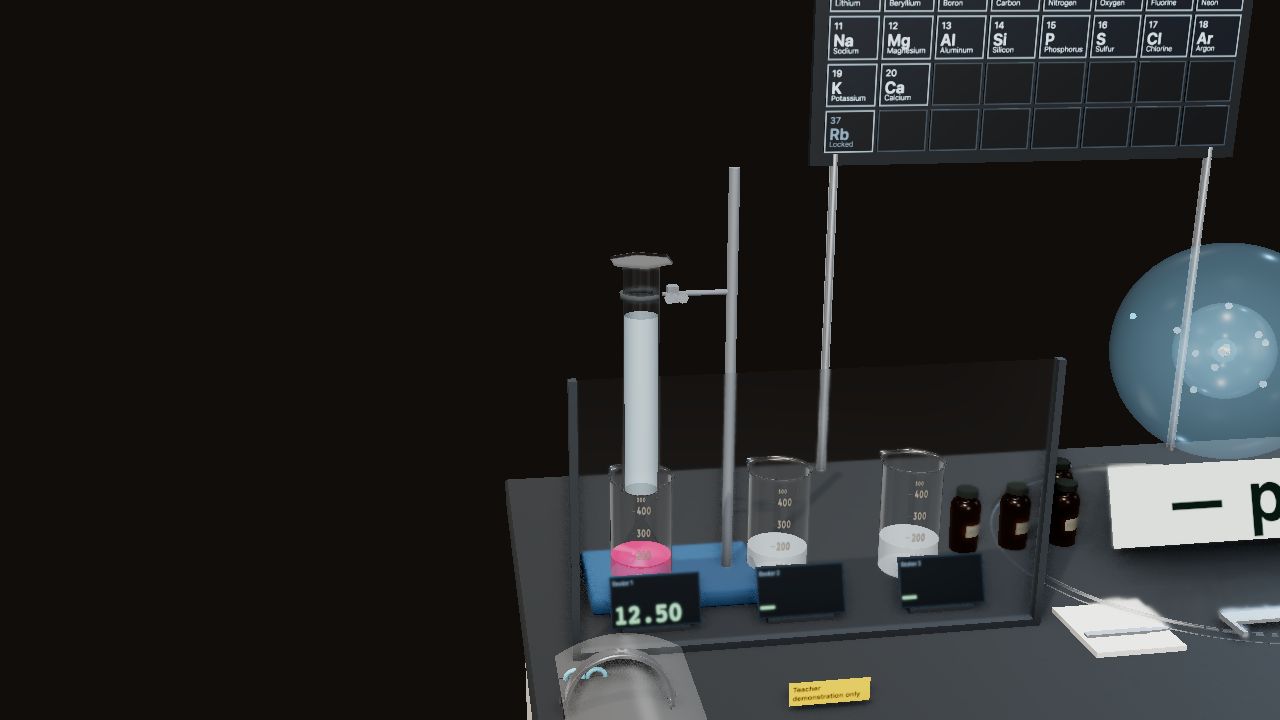
Chemistry
Periodic Trends & Reactivity
Drop lithium, sodium, and potassium into water, then pull electrons off their atoms. What explains what you see?


