Chemistry · CHM-002
Gas Laws
Squeeze, warm, and cool trapped air. Find absolute zero.
- NY HS-PS1-9
- AP Chemistry Unit 3
Included with a subscription. Create a free account to get started.

About this lab
Measure trapped gas as it is compressed or brought to different temperatures in a water bath. This interactive 3D experiment lets high school students move a syringe plunger and warm or cool the apparatus, comparing experiments that constrain gas temperature, container volume, or external pressure. The resulting pressure-volume and temperature plots can be fitted and extrapolated. A synchronized molecular view depicts particle motion and wall collisions. Measurements are interpreted with Kelvin temperature, the occupied gas volume, and the apparatus conditions, including sensor connections and thermal equilibration. The investigation is aligned with New York standard HS-PS1-9 and AP Chemistry Unit 3.
What you will investigate
This gas laws virtual lab compares pressure, volume, and temperature under controlled conditions. Seal a sample, change a piston position or water-bath temperature, and use instrument records to decide which relationship the experiment tests. The labels emphasize what stays constant: pressure–volume at fixed temperature, pressure–temperature at fixed volume, and volume–temperature at fixed pressure.
A fair gas-law comparison also keeps the amount of gas fixed. Changing the container while allowing gas to escape is not the same experiment as compressing a sealed sample. The course connects these macroscopic measurements with a particle view, where collisions with the container walls supply the pressure explanation. The drawn particles illustrate a mechanism rather than a literal count of all molecules in the sample.
Total volume includes the sensor space
The piston scale does not describe every part of the sealed gas volume. The course includes a 0.8 mL sensor dead volume. Add it when testing whether pressure multiplied by total volume remains constant. Omitting it can make the correct ideal relationship look imperfect, particularly at smaller piston readings.
| Ideal sealed-sample comparison | Pressure |
|---|---|
| Piston reading 5.0 mL | 188.63 kPa |
| Piston reading 20.0 mL | 52.60 kPa |
These examples use the prompt's pressure–volume setup sealed at a piston reading of 10.0 mL. They are model validation references. The volume in the calculation includes the extra sensor space, so a calculation using the piston reading alone is answering a different question. Keep the apparatus contribution visible instead of removing it merely to make a graph look straighter.
Kelvin temperature and equilibration
For a fixed amount and volume, pressure is proportional to absolute temperature in the ideal model. Convert the temperature scale before calculating a ratio. Celsius readings are useful for describing a water bath, but they cannot simply replace Kelvin values in a gas-law proportion.
The ideal pressure–temperature comparison gives 93.749 kPa in the 0°C bath and 128.071 kPa in the 100°C bath after equilibration. A changing bath temperature and the gas temperature are not necessarily identical during a transient. Waiting for the relevant reading to settle is therefore part of the experimental procedure, not an optional delay with no scientific purpose.
In Real mode, connecting tubing can remain nearer room temperature, a piston can experience friction, and the sensor can have an offset. These effects can change an extrapolated intercept. A fitted zero-pressure temperature should be interpreted in light of the apparatus and the range of data, rather than accepted automatically as a direct measurement of absolute zero.
Particle reasoning and model limits
The ideal gas equation PV = nRT connects the variables across the controlled comparisons. The particle explanation connects temperature with average kinetic energy and pressure with collisions. At the same temperature, lighter gas molecules can move faster while having the same average kinetic energy. Gas identity should not be confused with an additional pressure multiplier in the ideal equation.
The course also identifies departures from ideal behavior. The ideal approximation works best away from conditions where molecular attractions, occupied molecular volume, or condensation become important. A real-gas comparison does not invalidate the useful controlled ideal relationship; it identifies where that relationship needs additional assumptions.
Standards and classroom use
The principal catalog connections are New York HS-PS1-9 and AP Chemistry gas topics. Ask students to specify the fixed variables, label all units, and explain why the sensor space or temperature response changes their analysis. For another chemical measurement investigation, continue with titration. For a different controlled mechanical comparison, try Newton's second law.
Build an explanation from your records
Make a prediction before changing the conditions, then record a comparison that actually tests it. Keep the conditions attached to each row: a number without its setup can be misleading even when the arithmetic is correct. Explain what changed, what stayed fixed, and which observation supports your conclusion. If the result differs from your prediction, revise the explanation using the evidence rather than choosing a new answer without a reason.
The reference examples on this page describe the course model or its stated source data. They are not measurements collected from a physical laboratory by the reader. Compare like conditions, keep units visible, and distinguish rounded instrument displays from underlying model quantities. Use the investigation's stated limits when deciding whether a result can be generalized beyond the simulated setup. This guide supports preparation and interpretation; practical laboratory technique and safety training remain separate learning activities.
Common questions
Standards alignment
- NY HS-PS1-9
- AP Chemistry Unit 3
More Chemistry labs
- Members
Chemistry
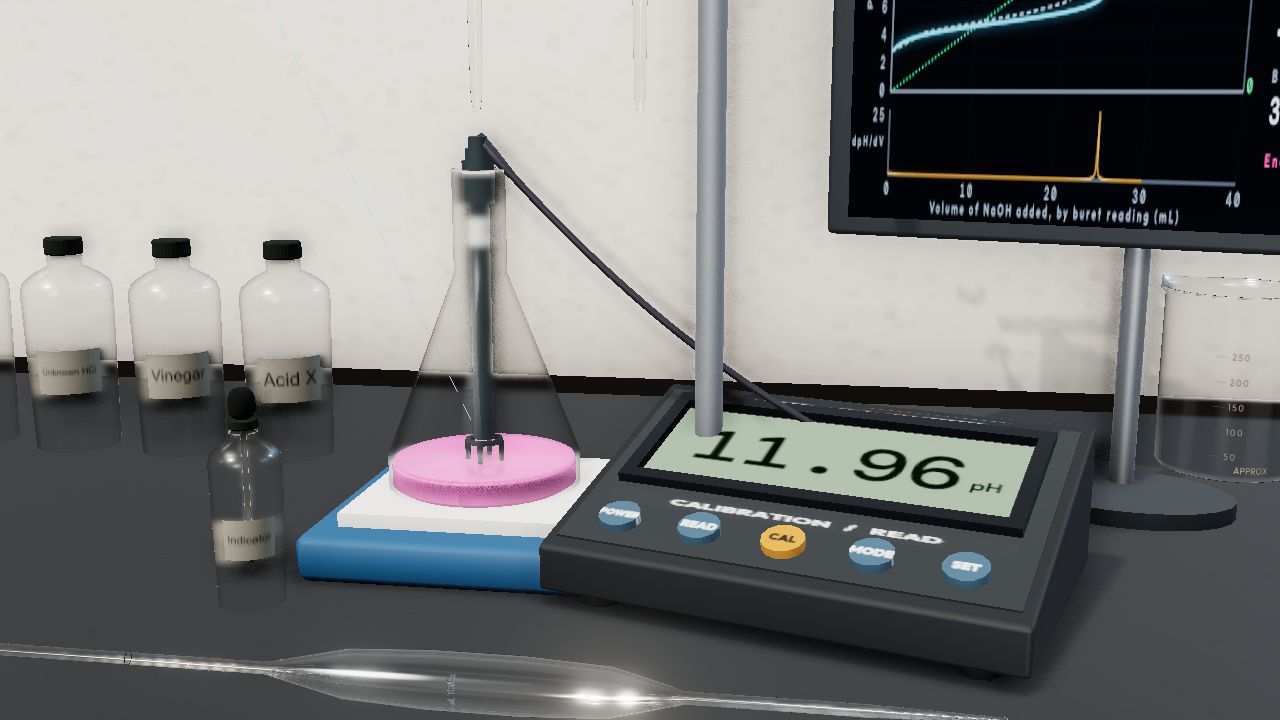
Acid–Base Titration
One drop, six pH units. Find the equivalence point and pKa.
- Members
Chemistry
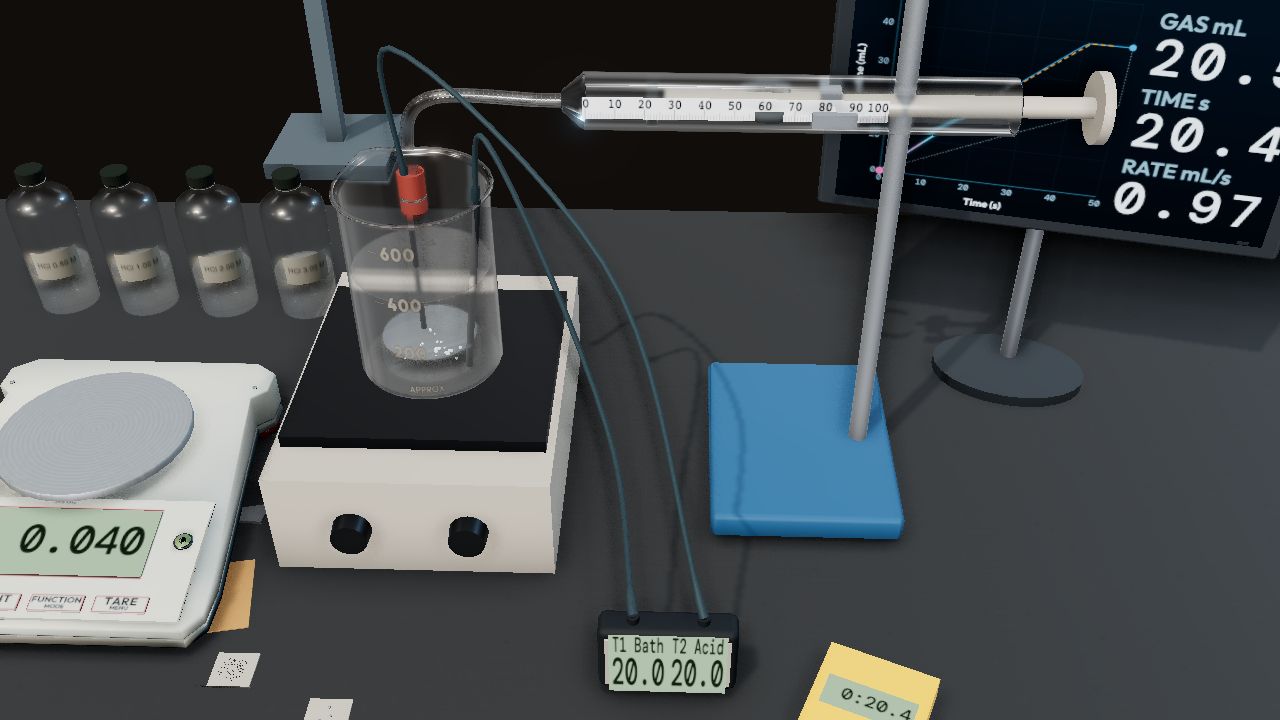
Reaction Rates
Magnesium in acid: change one condition, time the gas.
- Members
Chemistry
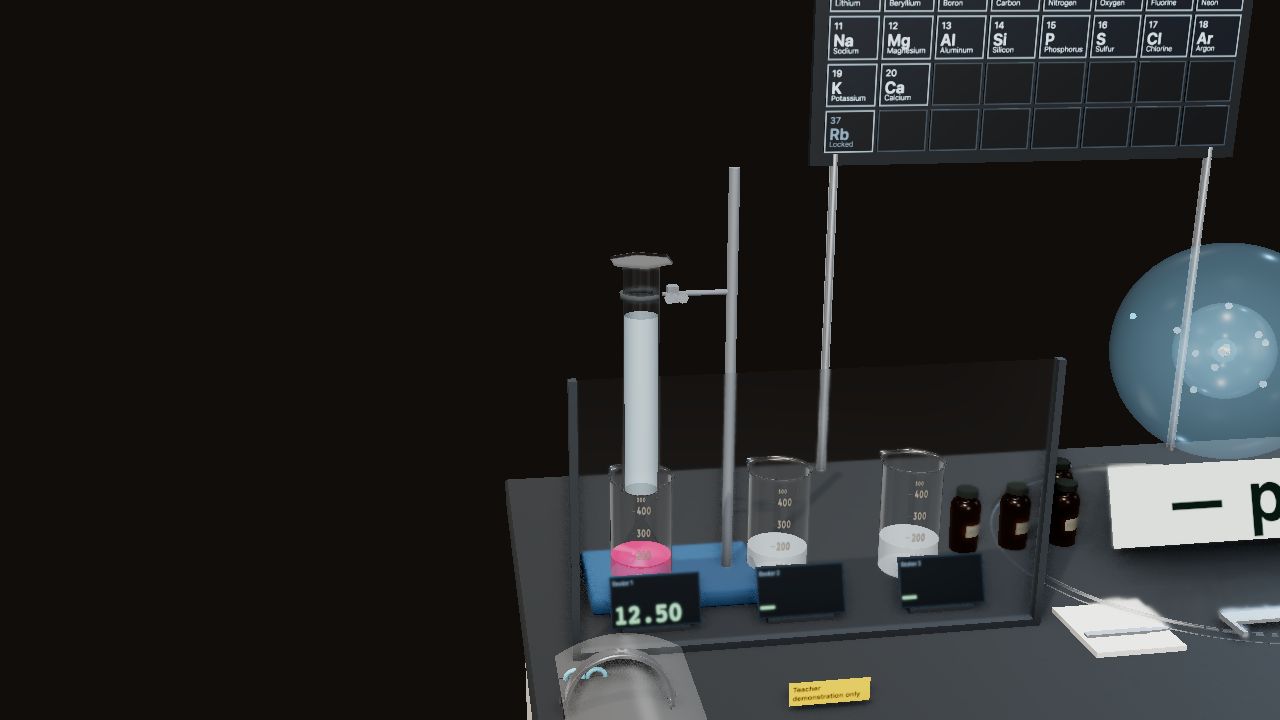
Periodic Trends & Reactivity
Drop lithium, sodium, and potassium into water, then pull electrons off their atoms. What explains what you see?


