

Greenhouse Effect Simulation: IR & Energy Balance
Two bottles under a lamp, one with extra CO₂. Which warms more, and why?
Greenhouse gases let incoming solar visible light pass while absorbing and re-emitting outgoing terrestrial infrared radiation, creating a top-of-atmosphere radiative imbalance until Earth warms enough to restore energy balance. In this interactive 3D greenhouse effect simulation, students test air, CO2, and argon bench boxes to separate convection from radiation, inspect IR/UV molecular absorption, and run a 60-year planetary climate model.
- 11 languages
- Laptop · tablet · phone
- Members
Create a free account to get 2 lifetime Free Lab Passes for any labs in the library. The course guide on this page stays free.

Inside this lab
- 1
Preview
- Driving question
- What you will predict
- Equipment and safety
- 2
Lab
- Lock in prediction
- Run the experiment, measure and replay
- Your notebook fills in as you go
- 3
Check
- Did the lab agree with you?
- Claim, evidence, reasoning
- Check questions and a printable lab report
How the greenhouse effect works in a climate change simulation
Understanding Earth's energy balance in a climate change simulation requires separating tabletop air-trapping from planetary radiative physics—and separating radiative forcing from climate feedbacks:
| Molecule / Component | Infrared (~6–15 um) Behavior | Ultraviolet (254 nm) | Role in Planetary Energy Balance |
|---|---|---|---|
N2, O2, Ar | Negligible (no dipole-allowed vibration) | Negligible | Make up 99% of dry air; transparent to both visible sunlight and outgoing IR |
CO2 (14.99 um bend) | Strong (54.2 km/mol) | Negligible | Primary long-lived radiative forcing driver (GWP_100 = 1, F = 5.35 * ln(C / 280)) |
H2O (6.27 um bend) | Strong (62.5 km/mol) | Unverified/negligible | Fast amplifying feedback (~+7% vapor per 1 K warming) |
CH4 (7.66 um deform) | Strong (33.4 km/mol) | Unverified/negligible | Potent greenhouse gas (GWP_100 = 27 non-fossil / 29.8 fossil) |
O3 (9.60 um stretch) | Strong (84.1 km/mol) | Strong (breaks bond) | Absorbs solar UV in stratosphere and traps terrestrial IR |
In the Atmosphere station (S_abs = 240 W/m^2 absorbed sunlight, pre-industrial C_0 = 280 ppm, T_0 = 15.0 deg C), raising CO2 produces immediate radiative forcing F = 5.35 * ln(C / 280), lowering outgoing longwave radiation (OLR = 240 - N). Without feedbacks (lambda_0 = 3.22 W/(m^2 K)), doubling CO2 to 560 ppm warms Earth by +1.15 K; enabling water-vapor and ice-albedo feedbacks (lambda_fb = 1.24 W/(m^2 K)) raises equilibrium climate sensitivity (ECS) to +3.00 K.
Apparatus, safety notes, and step-by-step procedure
- Apparatus: Three-station 3D radiation and climate lab (
ESS-013-v0.3.2): (1) Bench Boxes (0.30 x 0.20 x 0.20 mpaired boxesAair control andBtest gasair/co2/argon, room22.5 deg C, lamps on0–1100 s, gas injected att = 500 s,10 stemperature logger); (2) Molecular Absorption Lens (N2,O2,Ar,CO2,H2O,CH4,O3undervisible 605 nm,infrared 6.27–15.0 um, andultraviolet 254 nmphotons); (3) Global Atmosphere Energy-Balance Model (CO2 = 180 / 280 / 420 / 560 / 1120 ppm, feedbacksoff/on,60-yeartrajectory ofOLR, imbalanceN, anddelta T, plus1960–2024Mauna Loa / temperature reference data). - Safety note (for physical lab prep): In a hands-on tabletop lamp experiment, heat lamps reach burn temperatures—keep flammable materials away from bulbs and handle pressurized
CO2or argon cylinders only under instructor supervision.
- Start at the Bench station in Ideal mode with Box
A=airand BoxB=co2, turn the lamps on for the full1100 srun (CO2enters at500 s), and record final temperatures (T_A = 27.50 deg C,T_B = 31.77 deg C,rise B = +9.27 K). - Lock your argon control prediction, switch Box
Bto argon (same heavy-gas convection suppressionh = 0.6 W/(m^2 K), zero IR absorption), and re-run to1100 s. - Compute the ratio
Rise B(Ar) / Rise B(CO2)(8.90 / 9.27 = 0.96), proving that almost all warming in the small tabletop box came from suppressed convection rather than infrared absorption. - Open the Molecular Lens and fire
infrared,visible, andultravioletphotons atN2,O2,Ar,CO2,H2O,CH4, andO3, recording which molecules vibrate and re-emit IR vs. which break under UV (O3). - Switch to the Atmosphere energy-balance station (
C_0 = 280 ppm,OLR = 240.0 W/m^2), lock your energy-imbalance prediction, setCO2 = 420 ppmwithfeedbacks = off, and run60 years. - Record Year
0immediate forcing (F = +2.17 W/m^2,OLR = 237.8 W/m^2) and Year60equilibrium warming (delta T = +0.67 K) asOLRreturns to240.0 W/m^2. - Repeat at
420 ppmwithfeedbacks = onto observe how added water vapor amplifies warming to+1.75 K(2.6×larger) and lengthens adjustment time (tau = C_h / lambda). - Test
560 ppm(2x CO2) and1120 ppm(4x CO2) withfeedbacks = onto verify logarithmic forcing (+3.71and+7.42 W/m^2) and+3.00 Kwarming per doubling. - Compare the
180 ppmglacial preset against modern420 ppmand the embedded1960–2024observational dataset (316.9to424.6 ppm, anomaly-0.02to+1.29 deg C). - Switch the bench station to Real mode to inspect how lamp output jitter (
±3%) and probe noise (±0.1 K) require matching the samedeviceIdwhen comparingCO2againstargon.
Recording table and model reference data
Model reference data — run your own trials in the 3D lab. Values below reflect Ideal mode (
ESS-013-v0.3.2) tabletop bench endpoints (t = 1100 s, room22.50 deg C) and60-yearglobal atmosphere runs (S_abs = 240.0 W/m^2).
| Trial | Independent Variable (Station, Gas or CO2 & Feedbacks) | Dependent Variable (Temp Rise, Forcing F, Year-0 OLR & delta T) | Units | Observation |
|---|---|---|---|---|
| Ref 1 | Bench Box B: air vs. argon vs. co2 (t = 1100 s) | Rise = +5.00 (air) / +8.90 (Ar) / +9.27 (CO2) | K | Heavy non-IR argon captures 96% of the bench rise by blocking convection |
| Ref 2 | Atmosphere: 420 ppm, feedbacks = off vs. on | F = +2.17, OLR_0 = 237.8; delta T_60 = +0.67 (off) / +1.75 (on) | W/m^2, K | Water-vapor and albedo feedbacks amplify CO2 warming by 2.6× |
| Ref 3 | Atmosphere: 560 ppm (2x CO2), feedbacks = off vs. on | F = +3.71, OLR_0 = 236.3; delta T_60 = +1.15 (off) / +3.00 (on) | W/m^2, K | Doubling CO2 yields +3.00 K equilibrium climate sensitivity (ECS) with feedbacks |
| Ref 4 | Atmosphere: 1120 ppm (4x CO2), feedbacks = on | F = +7.42, OLR_0 = 232.6; delta T_60 = +6.00 | W/m^2, K | Each doubling adds equal radiative forcing (+3.71 W/m^2) and equal warming (+3.00 K) |
| Your Trial | Record station, gas or CO2 (ppm), feedbacks (on/off), mode | Record T_A, T_B, Rise, or F, OLR, N, delta T at Year 0 & 60 | deg C, K, W/m^2 | Compare Ar and CO2 runs from the same Real-mode lamp calibration |
Lab report outline (blank template)
- Title: State the mechanism tested (e.g., separating convection from IR absorption in bench boxes and modeling
CO2climate feedbacks). - Purpose: Define how the argon control, molecular lens, and global energy-balance model explain planetary greenhouse warming.
- Hypothesis: Predict the bench
Ar / CO2rise ratio and how enabling climate feedbacks alters equilibrium warming at420and560 ppm. - Variables: Identify test gas (
air/Ar/CO2),CO2concentration (ppm), and feedback toggle (independent);T_A,T_B,F,OLR,N, anddelta T(dependent);240 W/m^2absorbed sunlight,1100 sbench time, and60-yearhorizon (controlled). - Data Table: Log bench gas, final
T_A/T_B (deg C), rise (K), and atmosphereCO2 (ppm), feedbacks, Year-0OLR (W/m^2),F (W/m^2), and Year-60delta T (K). - Analysis & Calculation: Compute
Rise(Ar) / Rise(CO2), verifyF = 5.35 * ln(C / 280)anddelta T_eq = F / lambda, and compare model warming at420 ppmagainst observed1960–2024records. - Conclusion & Sources of Error: Explain why the argon control prevents false tabletop claims about
CO2IR trapping, and discuss Real-mode lamp jitter (±3%), probe noise (±0.1 K), and single-box ocean heat-capacity simplifications.
Continue exploring climate feedbacks and carbon chemistry
Test how melting ice lowers planetary reflectivity in Albedo & Ice Feedback, trace global carbon reservoirs in Carbon, Nitrogen, Phosphorus & Water Cycles, investigate dissolved CO2 in seawater in Ocean Acidification, or browse all Earth Science Labs.
Common questions
How does the greenhouse effect warm Earth's surface?
Earth absorbs roughly 240 W/m2 of solar radiation and emits infrared (IR) thermal radiation around 10 micrometers. Greenhouse molecules absorb outgoing IR and re-emit it in all directions—including back downward—reducing outgoing longwave radiation to space until the surface warms to restore balance.
Why does the lab test heavy argon gas alongside CO2 in the bench box?
Both CO2 and argon are denser than air and suppress convective heat loss in a tabletop box. Testing IR-transparent argon (which still warms by +8.90 K vs. +9.27 K for CO2) proves that a classroom jar experiment mainly shows trapped convection rather than pure radiative greenhouse warming.
Which gases are greenhouse gases and why do N2 and O2 not absorb infrared?
CO2, H2O, CH4, and O3 are greenhouse gases because their asymmetric bending or stretching vibrations change their molecular electric dipole moment and strongly absorb IR photons. Monatomic argon and homonuclear N2 and O2 lack dipole-allowed vibrations, so IR passes right through them.
How does doubling CO2 from 280 ppm to 560 ppm affect Earth's energy balance?
Using Myhre's logarithmic forcing formula F = 5.35 * ln(C / 280), doubling CO2 adds +3.71 W/m2 of radiative forcing, immediately dropping outgoing longwave radiation from 240.0 to 236.3 W/m2 and warming Earth by +1.15 K without feedbacks or +3.00 K with water-vapor and ice-albedo feedbacks.
Why does atmospheric temperature keep rising for decades after a step change in CO2?
Oceans give Earth's climate system a large effective heat capacity (2.52e8 J/(m2 K) in this model), so warming approaches the new equilibrium exponentially over an e-folding time scale of years to decades until net imbalance N returns to zero.
What is the difference between the greenhouse effect and ozone UV absorption?
Greenhouse warming involves infrared absorption by CO2, H2O, CH4, and O3 vibrating and re-emitting heat, whereas stratospheric ozone (O3) absorbs energetic ultraviolet (254 nm) photons by breaking chemical bonds (photodissociation).
Related interactive labs
- Members
 Earth Science
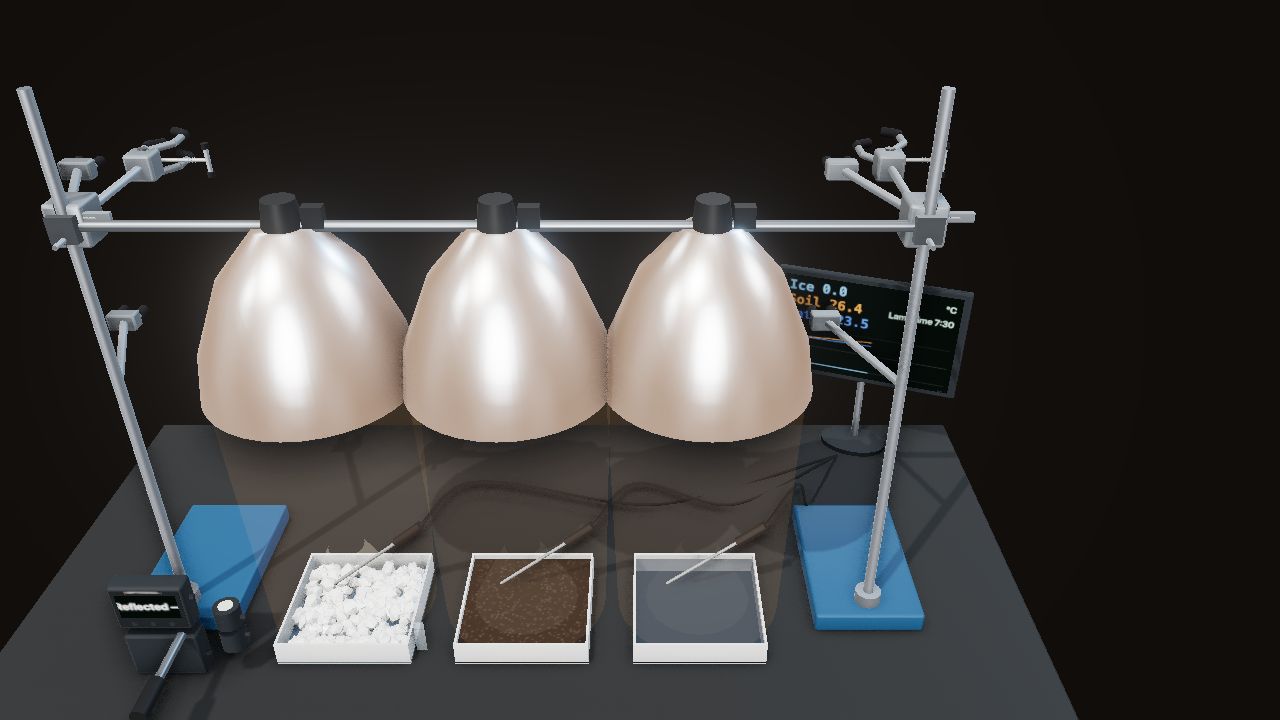
Albedo & Ice Feedback
Shine a lamp on ice, dark soil, and water.
- Members
 Environmental
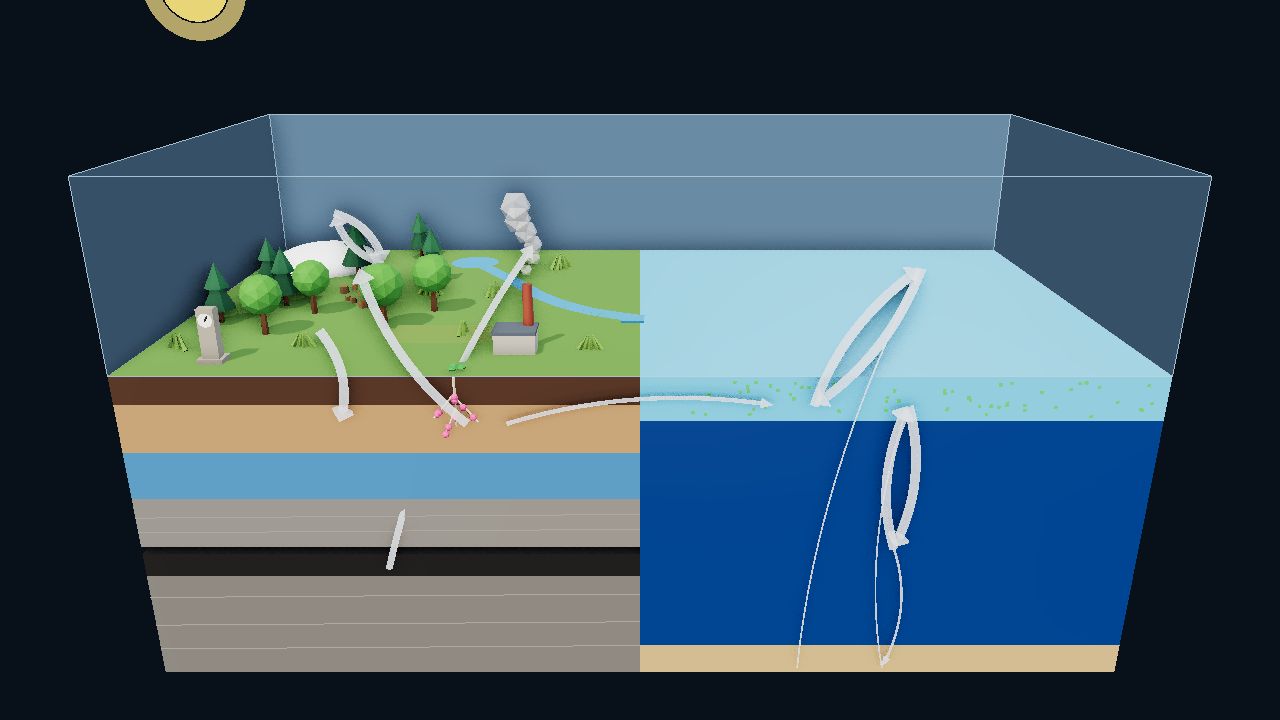
Carbon, Nitrogen, Phosphorus & Water Cycles
Follow single atoms of carbon and nitrogen through air, ocean, rock, and life.
- Free
 Environmental
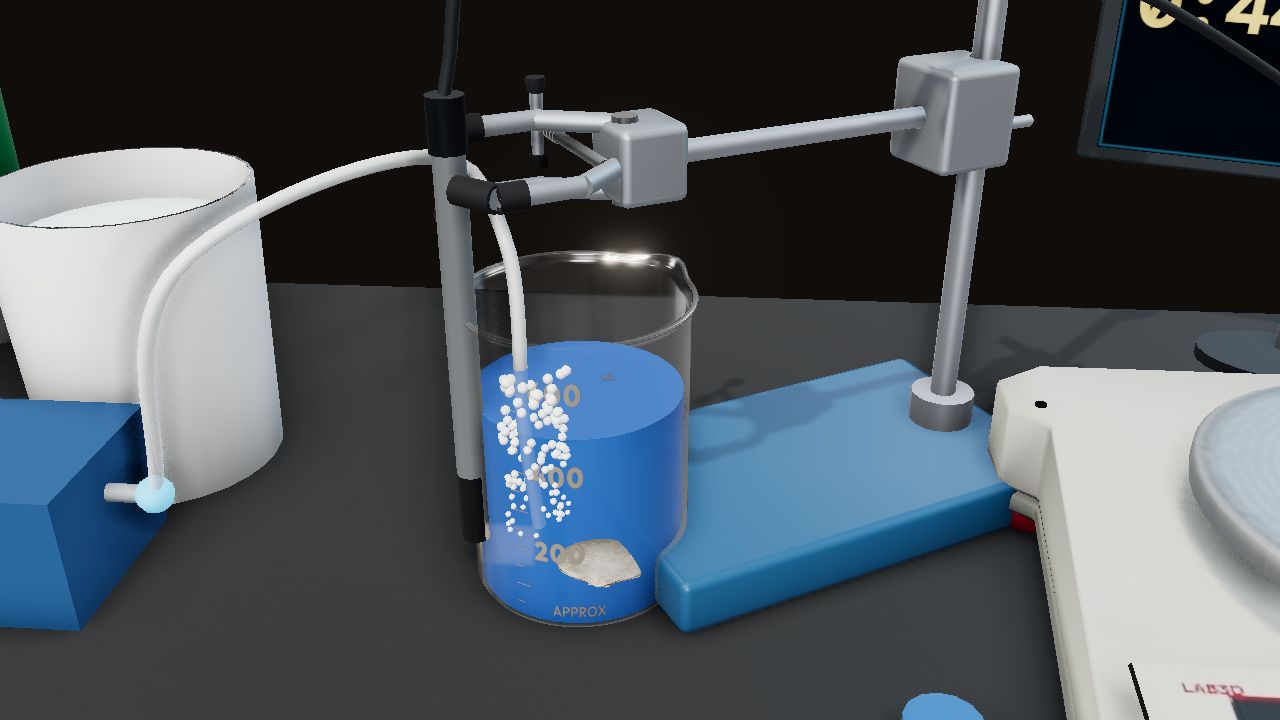
Ocean Acidification
Bubble CO₂ into seawater with a shell inside.


